WRITING
WRITING
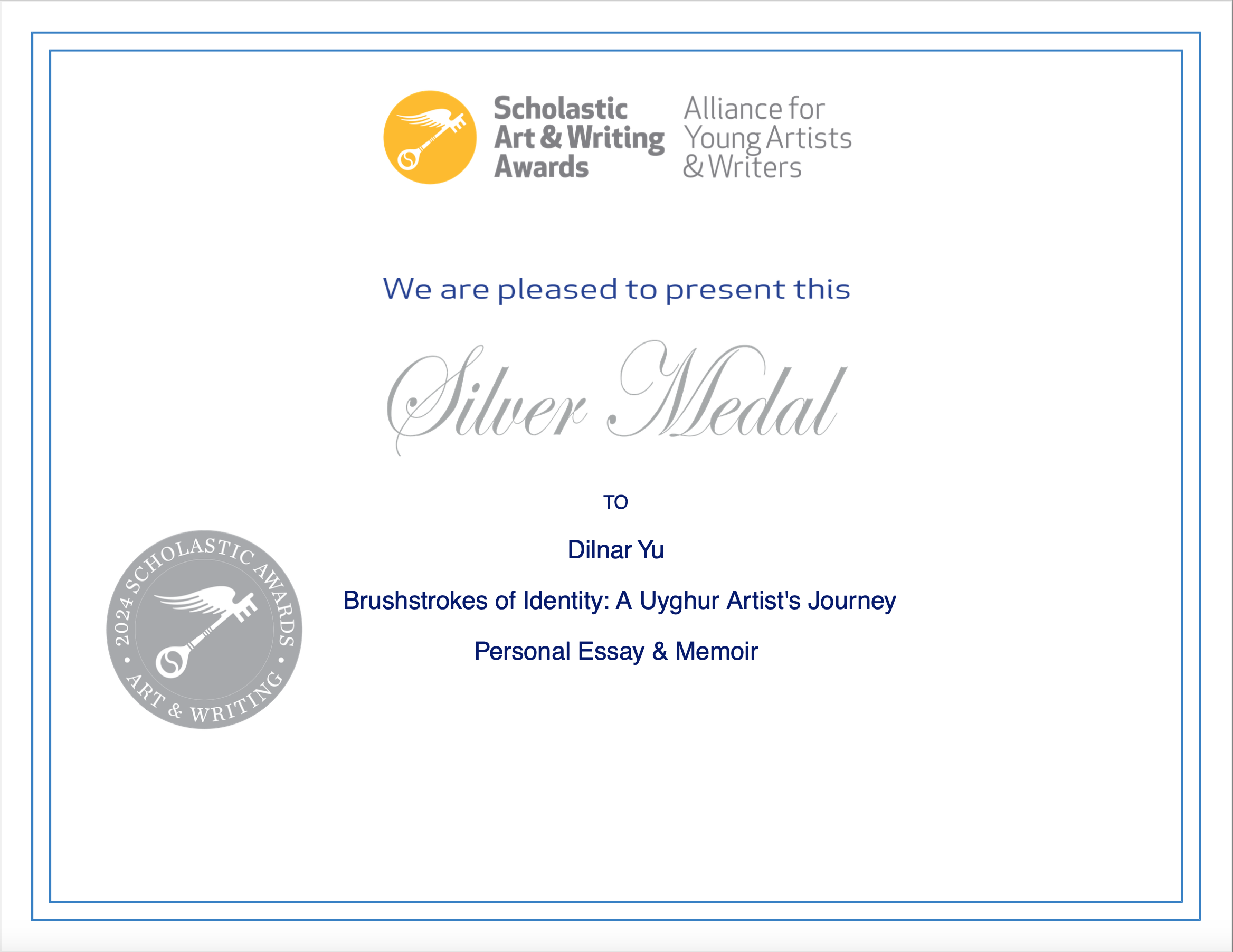
My memories of distant Uyghur life often come to me in my dreams: "Welcome to my Winter Art Exhibition!"
2022 FaceTime Family, Digital Media
On a warm summer evening, celebrating my first visit to the new high school campus, my father and I enjoyed a meal at an elegant sushi restaurant in Tustin. The sunset cast a vibrant tapestry of orange and red across the sky, complemented by the soft caress of a Southern California breeze. Our exquisite meal commemorated my move to a high school in Newport Beach. Coincidentally, an NBA superstar dined beside us. Simple greetings turned into conversation and soon he expressed concern upon learning about my mother's predicament.
In our intermittent conversation, he asked, "Where’s your mom?"
"Far away! We’ve been a FaceTime family for six years," I replied, summarizing the exit-ban for Uyghurs in China.
"That’s unbelievable!" He sympathized, kindly offering assistance.
I smiled, touched by the gesture.
Our family’s self-exile was a choice made to balance opportunity with safety. Yet, I occasionally ponder:
Would staying in China have been the wiser decision, forfeiting the chance for an American education? When Uyghurs venture abroad, their extended families at home often endure the terror of oppressive policies: relentless harassment, continuous threats, and the dread of re-education camps. My mother remained in China to protect her family, while I, to avoid being ensnared again, stayed away. This separation has imparted a profound understanding of life’s harsh realities and the weight of sacrifices. For the sake of a superior education and a hopeful future, I am committed to remaining in America, pledging to maintain my connection to my Uyghur heritage.
When we returned home, I revisited my past artwork, reaching for memories to anchor my present
2015: Fading Voices, Watercolor
My story starts in Korla, an oasis on the Silk Road near the Taklamakan Desert. After a childhood that was largely positive, my community began experiencing tightened surveillance and travel constraints in 2014.
In third grade, our school ceased the Uyghur-Chinese bilingual program. We were discouraged from speaking Uyghur, and pressure to conform led to our language being whispered in quiet defiance.
My friend Bahagul continued to speak Uyghur openly, and as she did, our once-frequent conversations dwindled. Her warm Yakh-xi-mu! greetings eventually gave way to Mandarin tinged with a hometown accent.
Out of fear of being targeted for possessing controversial material, families hastily disposed of Uyghur literature. None wished to risk the nightmare of re-education camps.
Walking in the footsteps of ancient Silk Road travelers, I carry forward the narratives of our suppressed voices and fading heritage, trusting that our stories, like an oasis, will once again flourish.
2017: Wall and Freedom, Mixed Media
For over a decade, my mother struggled to secure an exit stamp on my U.S. passport. I may have been the sole U.S. citizen confined to Korla for eleven years. A deep longing for freedom inspired me to reimagine myself as a mermaid. Departing China as Uyghurs is fraught with challenges. By a stroke of fortune, in 2017, I managed to leave, overcoming an invisible barrier to freedom. On February 28, I took a flight, surmounting the invisible wall, and began my Californian adventure. We departed just as the travel ban on Uyghurs intensified. Shortly thereafter, like many others, my mother was coerced into surrendering her passport. As a mermaid embarks on a voyage, so did I cross the Pacific with my father, leaving behind my previous life.
At border control, while being questioned, I envisioned a girl struggling to free herself from a chain tied to her ankle. This imagery later inspired my piece, Dance-Uyghur-Dance.
Reflecting on these early pieces in my portfolio, I noticed their raw style. Yet, the consistent thread has been the exploration of my unique upbringing.
2017: Guli in Other-Shore, Mixed Media
Since that time, I've been diligently working to recover lost time and carve out my educational trajectory in the U.S. An important phase involved nine months of intensive preparation for acceptance into a prestigious boarding school. If anything, the preparation process forced my skills to improve at an accelerated rate. After two enriching years, I faced two setbacks: my plan to take AP art was sidelined by the school's other commitments, and creating an off-campus art portfolio was hindered by weekend policies against leaving campus. This led me to transfer to a public high school that better supported my artistic ambitions and objectives.
Under the mentorship of an extraordinary Korean artist, I have cultivated my passion for art in the past six years. Meanwhile, my musical talents have developed since my 7th grade playing the double bass in the school orchestra for almost six years now. Outside of school, I’ve explored piano, cello, classical guitar, electric jazz guitar, and vocal performance. My artistry soared when I produced a short video reciting poetry, earning high praise from my English teacher as the best of the last few years.
As I traverse this path, each brushstroke on my life's canvas is a note in a symphony of passion and perseverance, composing a masterpiece of boundless possibilities in a land of dreams.
2023: Nuke Lop Nur, Film
While my birthplace is near the legendary Loulan Kingdom, the notorious Lop Nur nuclear test site is also within 200 miles. The legacy of nuclear testing and its impact on health lingers in the present.
Watching Oppenheimer in the cinema, the depiction of a nuclear explosion on the big screen almost made me recoil. My heart went out to the silent sufferers, their stories untold.
Back home, the reverberations of history persist, a testament to resilience and sacrifice, sculpting our collective narrative.
2016, Uyghur Voice, Oil Painting
One day during my fourth-grade year, I was at my best friend Aygul's house, enjoying Lagman and Kebab. Suddenly, a distant chant from an elder momentarily interrupted our meal and conversation. This venerable voice resonated intimately from afar. Everyone, including Aygul's family, paused in silence, their heads bowed, eyes closed, and palms facing their faces as a sign of deep respect. I realized they were acknowledging a Muslim prayer. It shouldn't be unreasonable to say that 97% of Han Chinese won't pray over a meal. Although unfamiliar with the practice, I joined in this meditative moment without fully understanding its significance. Later, I inquired with my mom, “What was that all about?” My mom explained, “The Adhan bridges our ordinary lives with moments of profound reflection, connecting us to the divine.”
It was an awakening experience etched into my memory. This mysterious experience from deep within the soul foreshadowed that VOICE would be a central theme in my artistic life.
2005, Hero Tree – Our Spirit, Sand Print
Despite relentless sandstorms and nuclear tests, the Populus Euphratica, or Toghrak, the hero tree, thrives. It stands as a symbol of the enduring Uyghur spirit: living a thousand years without falling, without dying, without decaying.
This symbol embodies the Uyghur people's indomitable spirit, a legacy from ancestors who endured hardships, fled dangers, and rebuilt their homes.
We hold a deeply rooted and sincere love for precious life.
2006 – 2017, Self-Portrait, Etching on Wall
Over the course of eleven years, my mother introduced me to the captivating realm of her monthly 'Uyghur Sisterhood' gatherings—lunch, dinner, or tea parties. Within this tightly knit circle of women, grace and elegance took center stage as they adorned themselves with the dignified Doppa caps, donned the flowing Chapan robes, or enveloped their figures in the opulent silk fabric known as Etles. Together, they forged bonds of unity through the graceful artistry of dance and the harmonious melodies of music, crafting a seamless fusion of culture and sisterhood.
These gatherings subtly influenced my artistic endeavors, finding expression in the murals that adorned my bedroom walls, where narratives and creativity blossomed. Now, thousands of miles from those walls, their legacy continues to fuel my art and existence. If beauty and potential could be cultivated on a blank wall, then surely, in this new chapter, I can craft an even more transcendent beauty and possibility.
Although the vast Taklamakan Desert was my home, my dreams painted me as an explorer tirelessly seeking the hidden gems of the world.
2023 - Future, Grand Vision: Renaissance, Film
My journey has choreographed my aspirations, directing them towards a vision of expressing my artistry, envisioning a fruitful creative vocation infused with the essence of Uyghur culture. My canvas shall dance with countless vibrant photons, each one a full-bodied expression of my identity.
Today, I immerse myself in my Uyghur heritage, delving into our history, culture, and artistic expressions. I am resolute in embracing life in all its facets, weaving together my Uyghur, Chinese, and American identities, advocating for justice and peace, and championing culture and art through my command of four languages.
My existence and lived experiences as a Uyghur girl will continue to evolve as a piece of a greater Uyghur Renaissance. Behold!
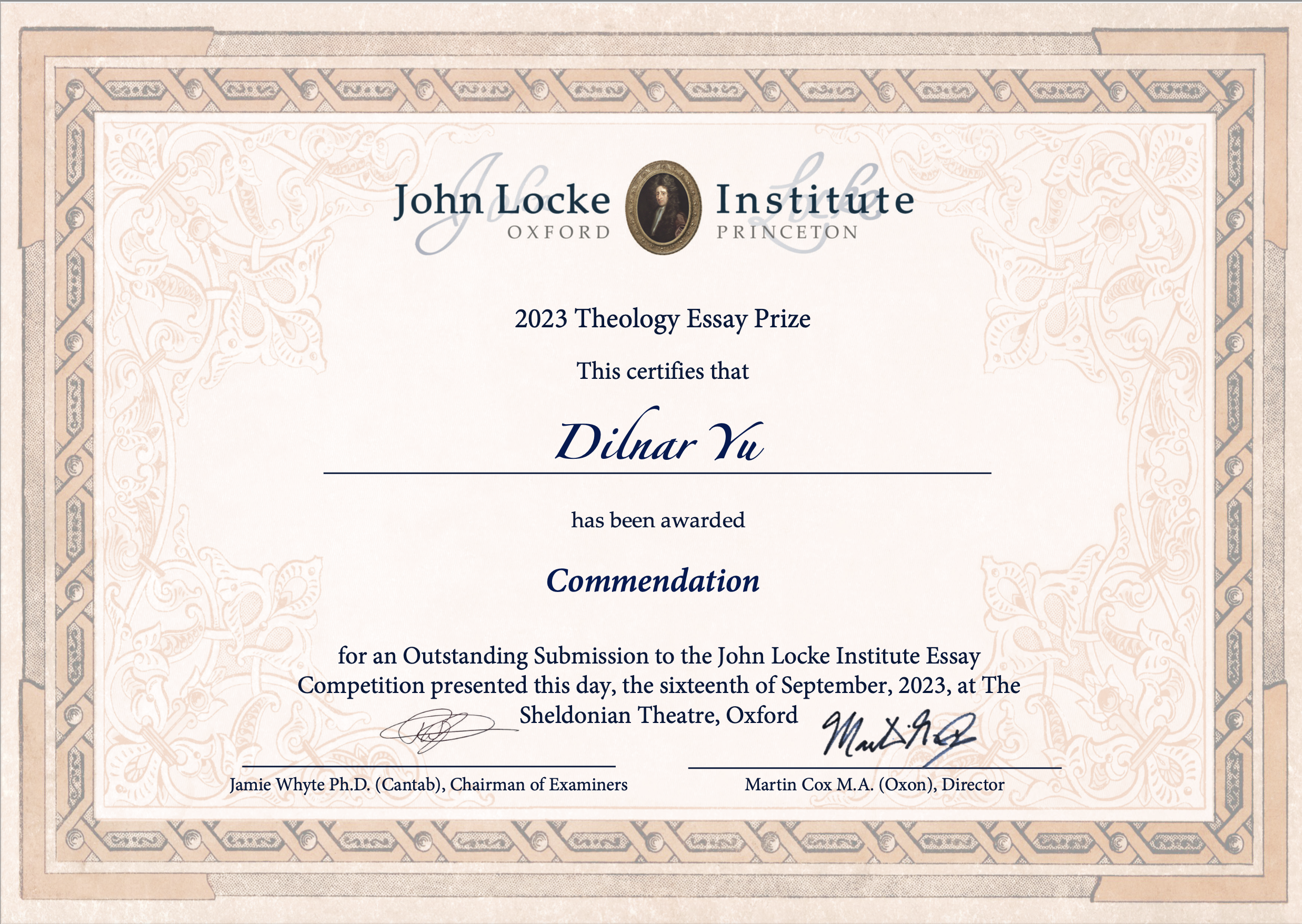
“What Was God Doing Before He Created the Cosmos?”
By Dilnar Yu
Introduction
In their quest to understand the true nature of reality and the ultimate purpose of the cosmos, humans have pondered, explored, and debated many philosophical, scientific, and theological theories throughout the ages but their quest for absolute certitude has been elusive. Part of the reason why these profound and complicated questions are perplexing is that the questions themselves possess a plethora of embedded assumptions which are themselves open to a myriad of interpretations. Consider the inquiry before us today: "What was God doing before he created the cosmos?" Unlike some inquiries which have a narrow scope and singular discipline, this question transcends a single field of study and bridges a wide spectrum of human knowledge. The very wording of the question itself is problematic, entailing linguistic analysis and verbal parsing simply before a proper quest can even begin.
1) What is “God”?
2) What does “before” mean if there is no sun to measure time?
3) What is the “cosmos”?
In addition, the question itself makes several unsubstantiated theological assumptions including:
1) God exists
2) God is singular and male
3) God is transcendent, omnipotent, and omnipresent
4) God is eternal, pre-dating the cosmos
5) God created the cosmos and the creation has ended
Yet, even when explicit definitions are established for each of the terms and these assumptions are addressed, the question itself still seems like the intractable, legendary Gordian Knot - either it is unanswerable or alternatively, it offers infinite possible solutions. In his provocative investigative documentary “To Seek Cosmic Origins,” Closer to Truth host Robert Kuhn states, “How things really begin often provide clues to what things are.” Yet L. J. Russell acknowledges appreciable impediments to providing definitive answers to questions like these.[i]
If history provides a guide, however, it would seem that it may be humanly impossible to solve the aforementioned question without a new methodology and theoretical framework.[ii]Theological and scientific answers to questions like these might in this way be reconciled or at least mitigated so that they are more accommodating instead of being in an adversarial relationship. As such, a paradigm shift is required, consisting of a full integration of many fields of investigation and inquiry into a unified framework. To provide a solution to the question “What was God doing before he created the cosmos?” I contend that investigators must embrace a more sophisticated interdisciplinary approach, deeply delving into multiple domains with a special concentration on epistemology, physics, evolution, and metaphysics.[iii] By adopting such a model, it is possible to accommodate both science and religion and argue that the creation of the cosmos has not ended and that “God” is still in the process of creating the cosmos through a process of continuous cyclic evolution.
II. Epistemology: How Do We Know?
Philosophers and theologians have long debated the nature of knowledge and how certainty can be obtained, whether through objective sensory observation and/or subjective divine revelation. Despite these vastly different viewpoints, virtually all persons will agree that the physical universe exists. It is an undeniable physical reality. No one can deny its actuality, similar to the way Descartes cannot doubt his own existence - "Cogito, ergo sum” (“I think, therefore I am.”)[iv] Furthermore, the cosmos is expanding and in a constant state of change just as all life forms change, age, and evolve. Nothing stays the same forever. These truths are not incompatible with a belief in “God” or “creation.” Sensory observation, human reasoning, and logic are essential for ascertaining truth and knowledge. They are not in opposition to faith in a divine being. However, to remain on solid footing, it is best not to venture into theological speculation or religious dogma.
III. Physics: What Is the Scale of the Universe?
In the 20th century, physicists realized that the structure of electrons and the nucleus of an atom is very similar to the structure of the eight planets and the Sun in our solar system.[v] The scaling factor between an oxygen atom with eight electrons and the solar system with eight planets is around 10^23.[vi] [vii] This scaling factor between the micro and macro worlds may offer significant clues whether the universe has boundaries. Although our cosmos is approximately 13.8 billion years old, neither can one assume that it will exist forever. In fact, Einstein demonstrated that space and time are the same.[viii]
IV. Evolution & The Cosmos: Cycles of Constant Change?
The earliest DNA and RNA molecule appeared approximately 4 billion years ago, which must be less than 4.5 billion years, the age of Earth and the Sun.[ix] If we assume the reproduction span of early viruses and bacteria to be 20 minutes,[x] there would be 2.6 * 10^4 generations in a year and 1 * 10^14 generations after 4 billion years, a total of 100 trillion generations of life cycles. Assuming human reproduction every 20 years, there would exist 0.2 * 10^9 generations after 4 billion years consisting of over 200 million generations of life cycles. The evolution of the whole evolution whole life tree is extremely long and still is going forward at this very moment.
Parallelism of DNA-Based Life Cycles and the Cosmos’ Big-Bang-Based Life Cycles
Modern cosmology is based on theories of Einstein’s general relativity, Georges Lemaître’s Big Bang theory, and Alan Guth’s Inflation model (supported by CMB picture).[xi] If we envision our current cosmic cycle, with a Big-Bang as starting point, as a micro cosmos, compared to a short-lived individual DNA-based life, the macro cosmos would be an evolving tree encapsulating the micro cosmos, each initiated with a different Big-Bang.
From the very first early most basic cosmos (like life form with least pairs of DNA codes – 160K[xii]) evolving to our current mind-boggling complex cosmos (like human being with 3 billion base pairs of DNA codes.[xiii]) Both evolution trees have a beginning, followed by finite steps, even though the steps could be a mind-boggling number. Regardless of millions or trillions of evolution steps, when compared to infinity, it would still seem like noting.
From earlier versions of the cosmos containing life forms with the least number of pairs of DNA codes – 160K[xiv]), our universe continues to evolve into a far more complex entity (similar to currently evolved human beings with 3 billion base pairs of DNA codes).[xv] In both of these cases, the evolutionary trees have a beginning, followed by a series of finite steps, even though these steps could be exceedingly complex. Regardless of millions or trillions of evolutionary steps, the entire process is still relatively short when compared to infinity.
While each person looks very similar to their parents, they are not identical. Likewise, it is possible to envision the previous cosmos and current cosmos being very similar but with small differences. However, the differences across countless generations of both humans and the cosmos will lead to immensely profound changes.
Like the first human cell zygote carrying a full set of human DNA pairs, each singularity of the big-bang would carry a full set of “cosmic DNA.” With our current technology, however, scientists are not yet able to determine what “cosmic DNA pairs” look like. They could be extremely small, perhaps a billion or a trillion times smaller than our current elementary particles such as the photon, electron, proton, neutron, or neutrino. What might it look like? Modern 10-dimensional superstring theory may provide vital clues about such “cosmic DNA pairs.”[xvi] Each human cell has the exact same DNA structure. Similarly, everything in one particular cosmos, regardless of its energy or material form, will have the identical “cosmic DNA pairs.” Just like both parents and their child start life from a tiny egg cell, both the previous cosmos and the current cosmos would start with a tiny egg of singularity with extreme high-density energy, carrying unique identity codes.
From the perspective of our expanded macro cosmic model, it becomes plausible to boldly speculate that there were other life cycles of the cosmos beyond our universe, as proposed by Roger Penrose in his cyclic model even though he assumes all cycles are exactly the same and eternal. However, it is more consistent with human biology and the DNA evolutionary tree that the cosmos also followed a multiplicity of time-bound varied generations. Ultimately, in each case, there is a life-death-life cycle. Just as the human lifespan is secretly encoded inside DNA that ends with death so also will the cosmos come to an end. Its death is encoded secretly inside the “cosmic DNA.” Ultimately, there is a God managing the entire evolutionary process. In this connection, modern cosmology presents a view of two phases of universal inflation. In the first phase which begins with the singularity of the tiny cosmic egg, the cosmos doubles every 10^ (-34) seconds for 100 cycles to an enormous size.[xvii] Then the second phase takes over as a slow expansion continues, as observed by Hubble around 100 years ago. Similarly, humans start as a single cell, doubling in size very quickly before birth. After the baby is born, however, the baby will grow slowly into adulthood.
V. Metaphysics
Duality of God
Based on the aforementioned line of reasoning, it is plausible to believe that “God” has similar duality: “God” could very conceivably fully design a person at the moment of conception, and still be with the individual throughout time, continuing to design and create an entire future life.
Similarly, “God” could have designed and created the cosmos at the split second of the Big Bang's starting point, while also continuing to design and create endless myriads of future cosmos’ within the original cosmos.
In each cycle, “God” is the creator of the next, who would then create the subsequent cycle ad infinitum. Simultaneously, “God's” overarching design and creative force continues, entwined with each subsequent iteration within the universe.
Nature of God
As such, “God” creates the natural law while simultaneously being inside the nature law. “God” creates quantum fields as well as the evolution of life. Based on what we observe in the DNA-based tree of evolution, “God” may have also created a tree of evolution in a super cosmos model. [xviii]
“God” therefore is the ultimate Creator who is simultaneously the greatest artist and greatest scientist. “God” is creating and designing a grand vision of this cosmos which will create creators who in turn will spawn endless generations of additional creators in an infinitude of time. Directly and indirectly, “God” is the ultimate physicist, mathematician, artist, warrior, politician, musician, playwright, and lover.
Without contradiction, many people can assuredly believe in modern physics, quantum mechanics, and general relativity as well as “God.” It would appear that “God’s” creation involves both intensive planning combined with infinite spontaneity.
VI. Conclusion
Altogether, the model I propose aligns remarkably well with contemporary scientific postulations including the Big-Bang theory, inflation theory, quantum mechanics duality, and principles governing the evolution of DNA-based life. There is significant corroborative support from both modern scientific and philosophical inquiry. It would appear from this investigation that “God” was always designing the universe and that “God” continues to superintend the process, directly and indirectly, in a constantly evolving and never-ending cycle of continuous development that not only produces unceasing change but also new generations and cycles of life.
Bibliography
Books
CSB Student Study Bible. Nashville, TN: Holman Bibles, 2021.
Swinburne, Richard. The coherence of theism. Oxford: Oxford University press, 2016.
Isaac Newton, The Principia: The Authoritative Translation and Guide: Mathematical Principles of Natural Philosophy (Berkeley, CA: University of California Press, 2016).
Ludwig Wittgenstein, Philosophical Investigations (Blackwell, 2001).
Hawking, Stephen. A brief history of time: From the big bang to black holes. Bronx, NY, USA: Ishi Press International, 2020.
Wittgenstein, Ludwig. Philosophical Investigations. Blackwell, 200.
Polkinghorne, John Charlton. Faith of a physicist - reflections of a bottom-up thinker. Princeton University Press, 2016.
Spinoza, Benedictus de. The book of god. New York, New York: Philosophical Library, 1958.
Shubin, Neil. Your inner fish: A journey into the 3.5-billion-year history of the human body. New York: Vintage Books, 2014.
Journal articles
Bianchi, U. and Stefon, . Matt. "dualism." Encyclopedia Britannica, December 13, 2022. https://www.britannica.com/topic/dualism-religion.
Blackburn, Simon. “Truth.” Encyclopædia Britannica. https://www.britannica.com/topic/truth-philosophy-and-logic.
Encyclopædia Britannica, “Law of Nature.” Encyclopædia Britannica. https://www.britannica.com/topic/law-of-nature.
Ellis, George F. R. “DOES THE MULTIVERSE REALLY EXIST?” Scientific American 305, no. 2 (2011): 38–43. http://www.jstor.org/stable/26002750.
Ferwerda, R. “Democritus and Plato.” Mnemosyne 25, no. 4 (1972): 337–78. http://www.jstor.org/stable/4430143.
Liu, S. (2020) The Essence of the Universe and Humankind. Open Journal of Philosophy, 10, 316-330. doi: 10.4236/ojpp.2020.103021.
Hug, L., Baker, B., Anantharaman, K. et al. A new view of the tree of life. Nat Microbiol 1, 16048 (2016). https://doi.org/10.1038/nmicrobiol.2016.48
Howell, Elizabeth, and Andrew May. “What Is the Big Bang Theory?” Space.com, January 10, 2022. https://www.space.com/25126-big-bang-theory.html.
Sutton, Christine. "Feynman diagram". Encyclopedia Britannica, 28 Feb. 2023, https://www.britannica.com/science/Feynman-diagram.
Tuttle, Russell Howard. “Human Evolution.” Encyclopædia Britannica, https://www.britannica.com/science/human-evolution.
Videos/Interviews:
Dawkin, Richard. Brian Greene Asks Richard Dawkins ... Does God Exist? YouTube, 2013. https://www.youtube.com/watch?v=SK48AsRIMM8.
Kuhn, Robert. To Seek Cosmic Origins | Episode 1711 | Closer To Truth. YouTube, 2020. https://youtu.be/DypFWCK4dnY.
Roger Penrose | The Next Universe and Before the Big Bang | Nobel Prize in Physics winner. YouTube. YouTube, 2019. https://www.youtube.com/watch?v=ftjwnjR0apY.
Shermer, Michael, Design in Evolution and the Possibility of Purpose in the Cosmos (Simon Conway Morris). YouTube, 2022. https://www.youtube.com/watch?v=WsCBbN-bM8E.
Websites
Biletzki, Anat, and Anat Matar. “Ludwig Wittgenstein.” Stanford Encyclopedia of Philosophy, October 20, 2021. https://plato.stanford.edu/entries/wittgenstein/.
De Cruz, Helen. “Religion and Science.” Stanford Encyclopedia of Philosophy, September 3, 2022. https://plato.stanford.edu/entries/religion-science/.
T, Yasin. Unity of allah (tawhid) | allah | al-islam.org. Accessed June 2023. https://www.al-islam.org/allah-yasin-t-al-jibouri/unity-allah-tawhid.
“Vaastu Metaphysics.” Shriguru Maharishi, November 24, 2019. https://shrigurumaharishi.org/ground-rules-of-vaastu/.
[i] Russell, L. J. “Human Knowledge: Its Scope and Limits.” Philosophy 24, no. 90 (1949): 253–60. http://www.jstor.org/stable/3747599.
[ii] Cynthia Grant and Azadeh Osanloo, “Understanding, Selecting, and Integrating a Theoretical Framework in Dissertation Research: Creating the Blueprint for Your ‘House,’” Administrative Issues Journal Education Practice and Research 4, no. 2 (2014), https://doi.org/10.5929/2014.4.2.9.
[iii] Bueno, Otavio, 'Epistemology and Philosophy of Science', in Paul Humphreys (ed.), The Oxford Handbook of Philosophy of Science, Oxford Handbooks (2016; online edn, Oxford Academic, 2 Sept. 2014), https://doi.org/10.1093/oxfordhb/9780199368815.013.13.
[iv] Britannica, The Editors of Encyclopaedia. "cogito, ergo sum". Encyclopedia Britannica, 28 Feb. 2023, https://www.britannica.com/topic/cogito-ergo-sum.
[v] Britannica, T. Editors of Encyclopaedia. "Bohr model." Encyclopedia Britannica, June 16, 2023. https://www.britannica.com/science/Bohr-model.
[vi] “NGLOS324 - Oxygen.” Oxygen. Accessed July 10, 2023. https://www.princeton.edu/~maelabs/mae324/glos324/oxygen.htm.
[vii] Carroll, B. W., & Ostlie, D. A. (2006). An Introduction to Modern Astrophysics (2nd Edition). Pearson/Addison-Wesley.
[viii] Britannica, T. Editors of Encyclopaedia. "space-time." Encyclopedia Britannica, May 11, 2023. https://www.britannica.com/science/space-time.
[ix] Urton, James. “First Cells on Ancient Earth May Have Emerged Because Building Blocks of Proteins Stabilized Membranes.” University of Washington News, August 12, 2019.
[x] Drexler M; Institute of Medicine (US). What You Need to Know About Infectious Disease. Washington (DC): National Academies Press (US); 2010. I, How Infection Works. Available from: https://www.ncbi.nlm.nih.gov/books/NBK209710/
[xi] Thompson, L. (2020). Understanding the Foundations of Modern Cosmology. In The Discovery of Cosmic Voids (pp. 1-17). Cambridge: Cambridge University Press. doi:10.1017/9781108867504.003
[xii] Than, Ker. “Smallest Genome of Living Creature Discovered.” LiveScience, October 14, 2022. https://www.livescience.com/1091-smallest-genome-living-creature-discovered.html.
[xiii] Chial, H. (2008) DNA sequencing technologies key to the Human Genome Project. Nature Education 1(1):219
[xiv] Than, Ker. “Smallest Genome of Living Creature Discovered.” LiveScience, October 14, 2022. https://www.livescience.com/1091-smallest-genome-living-creature-discovered.html.
[xv] Chial, H. (2008) DNA sequencing technologies key to the Human Genome Project. Nature Education 1(1):219
[xvi] Kaku, Michio. “M-Theory: The Mother of All SuperStrings.” Official Website of Dr Michio Kaku RSS. Accessed July 10, 2023. https://mkaku.org/home/articles/m-theory-the-mother-of-all-superstrings/.
[xvii] Siegel, Ethan. “What Was It like When the Universe Was Inflating?” Forbes, June 27, 2018. https://www.forbes.com/sites/startswithabang/2018/06/27/what-was-it-like-when-the-universe-was-inflating/?sh=1798309445c1.
[xviii] Flage, Daniel E. “The Essences of Spinoza’s God.” History of Philosophy Quarterly 6, no. 2 (1989): 147–60. http://www.jstor.org/stable/27743889